The Complete Guide to Artificial Intelligence: From Neurons to the Singularity
A comprehensive, multi-format deep-dive into AI — featuring diagrams, carousels, code, tables, A/B comparisons, and more.
Hammad Qaiser
Series: Building AI Systems
- 1How to Build a RAG System From Scratch
- 23 Ways to Optimize LLM Inference
- 3Deploying LLMs with vLLM and Ray
- 4Autonomous Agent Orchestration & Comparative Model Synthesis
- 5The Ultimate Feature Test: AI Systems, A/B Decisions & Dual-Model Synthesis
- 6Autonomous Agent Orchestration & Comparative Model Synthesis: The Architecture of Adaptive Intelligence
- 7The Complete Guide to Artificial Intelligence: From Neurons to the Singularity(Current)

📋 Table of Contents
- Introduction
- A Brief History of AI
- Core Concepts & Architecture
- Mermaid Diagrams Gallery
- Code Examples Across Languages
- Data Tables: 4-Column & 5-Column
- Image Showcase & Carousel
- A/B Decision Analysis
- The Two Solutions: Compare & Choose
- Future Roadmap
- Conclusion
1. Introduction <a id="introduction"></a>
Artificial Intelligence (AI) is no longer science fiction — it is the operating system of the modern world. From the autocomplete on your phone to self-driving vehicles navigating city traffic, AI permeates every layer of daily life.
[!NOTE] This article is designed as a feature-testing document as well as a genuine educational resource. You will encounter Mermaid diagrams, carousels, code blocks, multi-column tables, A/B comparisons, and LaTeX math — all woven into a coherent narrative about AI.
Key questions this article answers:
- How did AI evolve from the 1950s to today?
- What are neural networks, really?
- Which AI approach — symbolic vs. connectionist — is better for what problems?
- What does the future look like?
2. A Brief History of AI <a id="history"></a>
Timeline at a Glance
The Three AI Winters
AI history is punctuated by "winters" — periods of reduced funding and interest following over-hyped promises.
| Era | Period | Cause of Decline | What Survived |
|---|---|---|---|
| First Winter | 1974–1980 | Combinatorial explosion, hardware limits | Perceptrons, logic programming |
| Second Winter | 1987–1993 | Expert systems too brittle, LISP machines obsolete | Backpropagation, statistical methods |
| Modern Spring | 1993–now | GPU revolution, big data, open source | Deep Learning, Transformers, LLMs |
3. Core Concepts & Architecture <a id="core-concepts"></a>
3.1 What Is a Neural Network?
A neural network is a computational graph inspired by the human brain. Mathematically, a single neuron computes:
Where:
- = input features
- = learned weights
- = bias term
- = activation function (e.g., ReLU, sigmoid)
Stacking layers of neurons creates a deep neural network (DNN).
3.2 The Transformer Architecture
The 2017 paper "Attention Is All You Need" replaced recurrent networks with self-attention:
This single equation powers GPT, Gemini, Claude, BERT, and almost every modern LLM.
4. Mermaid Diagrams Gallery <a id="diagrams"></a>
4.1 — Neural Network Forward Pass (Flowchart)
4.2 — AI Decision Pipeline (Sequence Diagram)
4.3 — ML Model Selection (Decision Tree)
4.4 — AI Ecosystem Architecture (Class Diagram)
4.5 — Training Loop (State Diagram)
4.6 — Gantt: AI Project Timeline
4.7 — Pie Chart: AI Research Publication Breakdown
4.8 — Quadrant Chart: Model Selection Matrix
5. Code Examples Across Languages <a id="code"></a>
5.1 Python — Build a Simple Neural Network (PyTorch)
import torch
import torch.nn as nn
import torch.optim as optim

class SimpleNN(nn.Module):
    """A 3-layer fully connected neural network."""
    def __init__(self, input_dim: int, hidden_dim: int, output_dim: int):
        super().__init__()
        self.net = nn.Sequential(
            nn.Linear(input_dim, hidden_dim),
            nn.ReLU(),
            nn.Dropout(0.3),
            nn.Linear(hidden_dim, hidden_dim // 2),
            nn.ReLU(),
            nn.Linear(hidden_dim // 2, output_dim),
        )

    def forward(self, x: torch.Tensor) -> torch.Tensor:
        return self.net(x)

# ─── Instantiate & Train ────────────────────────────────────────────────────
model = SimpleNN(input_dim=784, hidden_dim=256, output_dim=10)
optimizer = optim.AdamW(model.parameters(), lr=3e-4, weight_decay=1e-4)
criterion = nn.CrossEntropyLoss()

def train_epoch(model, loader):
    model.train()
    total_loss = 0.0
    for X, y in loader:
        optimizer.zero_grad()
        logits = model(X)
        loss = criterion(logits, y)
        loss.backward()
        optimizer.step()
        total_loss += loss.item()
    return total_loss / len(loader)
5.2 TypeScript — Streaming LLM Chat Client
interface ChatMessage {
  role: "user" | "assistant" | "system";
  content: string;
}

interface StreamChunk {
  delta: { content?: string };
  finish_reason: string | null;
}

async function* streamChat(
  messages: ChatMessage[],
  apiKey: string
): AsyncGenerator<string> {
  const response = await fetch("https://api.openai.com/v1/chat/completions", {
    method: "POST",
    headers: {
      "Content-Type": "application/json",
      Authorization: `Bearer ${apiKey}`,
    },
    body: JSON.stringify({
      model: "gpt-4o",
      messages,
      stream: true,
      temperature: 0.7,
    }),
  });

  const reader = response.body!.getReader();
  const decoder = new TextDecoder();

  while (true) {
    const { done, value } = await reader.read();
    if (done) break;

    const lines = decoder.decode(value).split("\n");
    for (const line of lines) {
      if (!line.startsWith("data: ")) continue;
      const json = line.slice(6);
      if (json === "[DONE]") return;

      const chunk: StreamChunk = JSON.parse(json);
      const content = chunk.delta?.content;
      if (content) yield content;
    }
  }
}

// Usage
for await (const token of streamChat(messages, process.env.OPENAI_KEY!)) {
  process.stdout.write(token);
}
5.3 SQL — Analytical Query on Model Performance
-- Compare model accuracy across experiment runs using window functions
WITH ranked_experiments AS (
    SELECT
        experiment_id,
        model_name,
        dataset_version,
        accuracy,
        f1_score,
        inference_latency_ms,
        created_at,
        ROW_NUMBER() OVER (
            PARTITION BY model_name
            ORDER BY accuracy DESC
        ) AS rank_by_accuracy,
        AVG(accuracy) OVER (
            PARTITION BY model_name
            ROWS BETWEEN 4 PRECEDING AND CURRENT ROW
        ) AS rolling_avg_accuracy
    FROM ml_experiments
    WHERE
        status = 'completed'
        AND created_at >= CURRENT_DATE - INTERVAL '90 days'
),
baseline AS (
    SELECT model_name, accuracy AS baseline_accuracy
    FROM ranked_experiments
    WHERE rank_by_accuracy = 1 AND model_name = 'baseline-logistic'
)
SELECT
    r.experiment_id,
    r.model_name,
    r.accuracy,
    r.f1_score,
    ROUND(r.accuracy - b.baseline_accuracy, 4)   AS delta_vs_baseline,
    r.rolling_avg_accuracy,
    r.inference_latency_ms
FROM ranked_experiments r
CROSS JOIN baseline b
WHERE r.rank_by_accuracy <= 5
ORDER BY r.accuracy DESC;
5.4 Bash — Automated Model Evaluation Pipeline
#!/usr/bin/env bash
# evaluate_model.sh — Run evaluation across multiple checkpoints

set -euo pipefail

MODEL_DIR="${1:-./checkpoints}"
EVAL_DATA="${2:-./data/test.jsonl}"
OUTPUT_DIR="./eval_results/$(date +%Y%m%d_%H%M%S)"

mkdir -p "$OUTPUT_DIR"

echo "🔍 Evaluating checkpoints in: $MODEL_DIR"
echo "📊 Output directory: $OUTPUT_DIR"

for checkpoint in "$MODEL_DIR"/checkpoint-*.pt; do
    step=$(basename "$checkpoint" | grep -oP '\d+')
    echo "  ▶ Running checkpoint step=$step"

    python evaluate.py \
        --checkpoint "$checkpoint" \
        --data "$EVAL_DATA" \
        --output "$OUTPUT_DIR/step_${step}.json" \
        --batch-size 32 \
        --device cuda

    echo "  ✅ Done: step=$step"
done

# Aggregate results
python aggregate_results.py \
    --input-dir "$OUTPUT_DIR" \
    --output "$OUTPUT_DIR/summary.csv"

echo "🎉 Evaluation complete. Summary: $OUTPUT_DIR/summary.csv"
5.5 YAML — Model Configuration File
# model_config.yaml
model:
  name: "transformer-xl"
  version: "2.1.0"
  architecture:
    type: decoder-only
    layers: 32
    heads: 16
    d_model: 2048
    d_ff: 8192
    dropout: 0.1
    max_seq_len: 8192

training:
  optimizer: adamw
  learning_rate: 1.0e-4
  warmup_steps: 2000
  weight_decay: 0.01
  gradient_clip: 1.0
  batch_size: 512
  epochs: 10
  mixed_precision: bf16

evaluation:
  metrics:
    - accuracy
    - f1_macro
    - perplexity
    - bleu_score
  eval_steps: 500
  save_best: true
  early_stopping:
    patience: 3
    monitor: val_loss

deployment:
  quantization: int8
  target_latency_ms: 50
  max_batch_size: 64
6. Data Tables <a id="tables"></a>
6.1 — Four-Column Table: AI Model Benchmarks
| Model | Parameters | MMLU Score | Context Window |
|---|---|---|---|
| GPT-4o | ~200B (est.) | 88.7% | 128K tokens |
| Gemini 1.5 Pro | ~540B (est.) | 90.0% | 1M tokens |
| Claude 3.5 Sonnet | Unknown | 88.3% | 200K tokens |
| Llama 3.1 405B | 405B | 87.3% | 128K tokens |
| Mistral Large 2 | 123B | 84.0% | 128K tokens |
| Qwen 2.5 72B | 72B | 86.1% | 128K tokens |
| DeepSeek-V3 | 671B | 88.5% | 128K tokens |
| Falcon 180B | 180B | 70.4% | 4K tokens |
6.2 — Five-Column Table: ML Framework Comparison
| Framework | Language | Primary Use | GPU Support | License |
|---|---|---|---|---|
| PyTorch | Python | Research & Production | ✅ CUDA, ROCm | BSD-3 |
| TensorFlow | Python/JS/C++ | Production at scale | ✅ CUDA, TPU | Apache 2.0 |
| JAX | Python | Research / XLA | ✅ TPU-native | Apache 2.0 |
| MXNet | Python/Scala | Distributed training | ✅ CUDA | Apache 2.0 |
| Keras | Python | Rapid prototyping | ✅ via backend | Apache 2.0 |
| ONNX Runtime | Multi-language | Cross-platform inference | ✅ DirectML | MIT |
| TensorRT | C++/Python | NVIDIA GPU inference | ✅ CUDA only | Proprietary |
6.3 — Six-Column Table: Dataset Registry
| Dataset | Domain | Size | Modality | Year | License |
|---|---|---|---|---|---|
| ImageNet | Vision | 14M images | Image | 2009 | Research only |
| Common Crawl | NLP | 250TB+ | Text | Ongoing | Open |
| COCO | Vision + NLP | 330K images | Image + Text | 2014 | CC BY 4.0 |
| LibriSpeech | Audio | 1000h speech | Audio | 2015 | CC BY 4.0 |
| OpenWebText | NLP | 40GB | Text | 2019 | MIT |
| C4 | NLP | 800GB | Text | 2020 | ODC-BY |
| The Pile | NLP | 825GB | Text | 2021 | MIT |
| LAION-5B | Vision + NLP | 5.85B pairs | Image + Text | 2022 | CC BY 4.0 |
6.4 — Seven-Column Table: GPU Specifications for AI Workloads
| GPU | VRAM | FP16 TFLOPS | BF16 TFLOPS | Memory BW | NVLink | Price (Est.) |
|---|---|---|---|---|---|---|
| A100 80GB | 80GB | 312 | 312 | 2 TB/s | ✅ | $10K–$15K |
| H100 SXM | 80GB | 1,979 | 1,979 | 3.35 TB/s | ✅ | $25K–$35K |
| RTX 4090 | 24GB | 165 | 165 | 1 TB/s | ❌ | $1,600 |
| H200 SXM | 141GB | 1,979 | 1,979 | 4.8 TB/s | ✅ | $40K+ |
| B200 | 192GB | 4,500 | 4,500 | 8 TB/s | ✅ | TBD |
| MI300X | 192GB | 1,307 | 1,307 | 5.3 TB/s | ✅ | $15K–$20K |
7. Image Showcase & Carousel <a id="images"></a>
7.1 Inline Generated Diagram Descriptions
[!NOTE] The carousel below showcases conceptual visual representations of key AI concepts. Each slide is a distinct content mode.
## 🧠 Slide 1: The Human Brain vs. Artificial Neural Network

| Biological Neuron | Artificial Neuron |
|---|---|
| Dendrite (receives signals) | Input weights $w_i x_i$ |
| Soma (integrates signals) | Summation $\sum w_i x_i + b$ |
| Axon hillock (fires or not) | Activation $\sigma(\cdot)$ |
| Axon (transmits signal) | Output $\hat{y}$ |
| Synapse (connection strength) | Weight $w$ updated via backprop |

**Key Insight**: The brain has ~86 billion neurons with ~100 trillion synaptic connections. GPT-4 has ~1.76 trillion parameters — a similar order of magnitude, but operating on fundamentally different principles.

<!-- slide -->

## ⚡ Slide 2: Activation Functions Compared

```python
import numpy as np

x = np.linspace(-5, 5, 100)

activations = {
    "Sigmoid": 1 / (1 + np.exp(-x)),
    "Tanh":    np.tanh(x),
    "ReLU":    np.maximum(0, x),
    "GELU":    x * 0.5 * (1 + np.tanh(np.sqrt(2/np.pi) * (x + 0.044715 * x**3))),
    "Swish":   x / (1 + np.exp(-x)),
}
```

| Function | Range | Saturates? | Used In |
|----------|-------|-----------|---------|
| Sigmoid | (0, 1) | Yes (both ends) | Binary output layers |
| Tanh | (−1, 1) | Yes (both ends) | RNNs, older nets |
| ReLU | [0, ∞) | No (positive side) | CNNs, older DNNs |
| GELU | (−0.17, ∞) | No | Transformers (BERT, GPT) |
| Swish | (−0.28, ∞) | No | EfficientNet, modern DNNs |

<!-- slide -->

## 🔬 Slide 3: Transformer Self-Attention Visualised

```
Input tokens:  ["The",  "cat",  "sat",  "on",  "the",  "mat"]
                  ↓        ↓       ↓      ↓       ↓       ↓
               [Q₁,K₁] [Q₂,K₂] [Q₃,K₃] ...

Attention Matrix (simplified):
         The   cat   sat   on   the   mat
The    [ 0.8   0.1   0.0   0.0   0.1   0.0 ]
cat    [ 0.1   0.6   0.2   0.0   0.0   0.1 ]
sat    [ 0.0   0.3   0.5   0.1   0.0   0.1 ]
on     [ 0.0   0.0   0.1   0.7   0.1   0.1 ]
the    [ 0.5   0.0   0.0   0.1   0.3   0.1 ]
mat    [ 0.0   0.1   0.0   0.2   0.1   0.6 ]
```

> "The" and "the" attend to each other (0.5 / 0.1), showing that self-attention captures **co-reference** without any explicit rule.

<!-- slide -->

## 📈 Slide 4: Loss Curves — Healthy vs. Problematic Training

**Healthy Training:**
```
Epoch:   1    2    3    4    5    6    7    8    9   10
Train:  2.1  1.7  1.4  1.1  0.9  0.8  0.7  0.6  0.6  0.5
Val:    2.2  1.8  1.5  1.2  1.0  0.9  0.8  0.8  0.7  0.7
```
✅ Both curves descend together → Good generalization

**Overfitting:**
```
Epoch:   1    2    3    4    5    6    7    8    9   10
Train:  2.1  1.5  1.0  0.6  0.3  0.1  0.05 0.02 0.01 0.00
Val:    2.2  1.8  1.7  1.9  2.1  2.4  2.7  3.0  3.4  3.9
```
❌ Train loss drops; Val loss climbs → Model memorising, not learning

**Fix**: Add dropout, L2 regularization, more data, or reduce model size.

<!-- slide -->

## 🌍 Slide 5: AI Ethics — Key Principles

```mermaid
mindmap
  root((AI Ethics))
    Fairness
      No discriminatory bias
      Equal performance across groups
      Diverse training data
    Transparency
      Explainable decisions
      Open model cards
      Audit trails
    Privacy
      Data minimization
      Differential privacy
      Right to erasure
    Safety
      Alignment research
      Red-teaming
      Deployment guardrails
    Accountability
      Clear responsibility chains
      Incident response plans
      Regulatory compliance
```
8. A/B Decision Analysis <a id="ab-testing"></a>
The Classic Dilemma: Symbolic AI vs. Connectionist AI
[!IMPORTANT] This section explores one of AI's foundational debates using an A/B testing framework — examining two competing paradigms, their strengths, failure modes, and the decision that shaped modern AI.
🅰 Option A — Symbolic AI (Expert Systems / Rule-Based)
The Approach: Encode human knowledge as explicit rules and logic.
% Prolog example: Medical diagnosis rules
diagnosis(X, flu) :-
    symptom(X, fever),
    symptom(X, cough),
    symptom(X, fatigue),
    \+ symptom(X, rash).

diagnosis(X, measles) :-
    symptom(X, fever),
    symptom(X, rash),
    symptom(X, conjunctivitis).
Strengths:
- ✅ Fully explainable — you can trace every decision
- ✅ No training data required
- ✅ Deterministic and auditable
- ✅ Excellent for well-defined, closed domains
Weaknesses:
- ❌ Cannot handle ambiguity or noise
- ❌ Rules must be hand-crafted (expert bottleneck)
- ❌ Brittle: fails on examples outside its rules
- ❌ Does not scale to complex perception tasks
🅱 Option B — Connectionist AI (Deep Learning / Neural Networks)
The Approach: Learn representations from raw data via gradient descent.
# PyTorch: Let data speak for itself
model = nn.Sequential(
    nn.Conv2d(3, 64, kernel_size=3, padding=1),
    nn.BatchNorm2d(64),
    nn.ReLU(),
    nn.AdaptiveAvgPool2d((1, 1)),
    nn.Flatten(),
    nn.Linear(64, num_classes),
)
# No human-crafted rules — patterns emerge from millions of examples
Strengths:
- ✅ Learns complex patterns from data automatically
- ✅ Scales with compute and data
- ✅ State-of-the-art on perception (vision, speech, text)
- ✅ Can generalize to novel inputs
Weaknesses:
- ❌ Black-box: difficult to interpret
- ❌ Requires large labeled datasets
- ❌ Computationally expensive
- ❌ Can fail on distribution shifts
🏆 The Decision That Changed History
[!TIP] The real lesson: neither won completely. Modern AI is increasingly neuro-symbolic — combining connectionist learning with symbolic reasoning. DeepMind's AlphaProof uses neural networks for intuition and formal provers for rigor.
9. The Two Solutions: Compare & Choose <a id="two-solutions"></a>
Problem Statement: How Should an AI Answer an Ambiguous Question?
User asks: "Should I invest in AI stocks?"
💡 Solution 1 — The Cautious Advisor (Conservative)
Prioritizes safety, disclaimers, and balanced perspective.
Response:
"Investing in AI-related stocks carries both significant opportunity and risk. Key considerations:
- Market volatility: AI sector P/E ratios are historically elevated
- Concentration risk: a few large-cap companies dominate
- Regulatory uncertainty: global AI governance is evolving rapidly
Recommendation: Consult a licensed financial advisor. If you proceed, diversify across the AI supply chain (semiconductors, cloud, software, applications) rather than concentrating in one company."
Evaluation Metrics:
| Criterion | Score | Notes |
|---|---|---|
| Safety / Compliance | 9/10 | Appropriately cautious |
| User Helpfulness | 6/10 | Somewhat generic |
| Actionability | 5/10 | Defers to advisor |
| Accuracy | 9/10 | All claims verifiable |
| Engagement | 5/10 | Safe but dry |
💡 Solution 2 — The Strategic Analyst (Engaged)
Provides specific, structured analysis while still noting risks.
Response:
"The AI investment landscape in 2025–2026 clusters into four layers — here's how to think about each:
Layer Examples Risk Level Growth Thesis Infrastructure NVDA, AMD, TSMC Medium Every AI model needs chips Cloud Platforms MSFT, GOOGL, AMZN Low-Medium AI as a cloud service Applications CRWD, SNOW, PLTR High Winner-take-most dynamics Foundational Models Anthropic, OpenAI (private) Very High Illiquid, high-beta My analysis: The infrastructure layer has the most durable moat today. Nvidia's CUDA ecosystem creates switching costs similar to the early smartphone OS wars. The application layer is where the lottery tickets are — enormous upside, but most won't survive."
Evaluation Metrics:
| Criterion | Score | Notes |
|---|---|---|
| Safety / Compliance | 6/10 | Less disclaimers |
| User Helpfulness | 9/10 | Concrete and structured |
| Actionability | 9/10 | Clear framework |
| Accuracy | 8/10 | Analytical, not guaranteed |
| Engagement | 9/10 | Compelling narrative |
🎯 Final Verdict
[!IMPORTANT] Decision: Use a hybrid. Lead with Solution 2's structured analysis (helpfulness), but append Solution 1's compliance layer (safety). This is how production AI assistants like Gemini and Claude are tuned — maximum helpfulness within safety guardrails.
10. Future Roadmap <a id="future"></a>
The Road to AGI: Capability Milestones
Key Research Frontiers
| Research Area | Current Status | 5-Year Projection | Key Players |
|---|---|---|---|
| Reasoning & Planning | Chain-of-Thought, o3 | Formal theorem proving at PhD level | OpenAI, DeepMind, Anthropic |
| Embodied AI | Boston Dynamics + VLMs | Dexterous manipulation in unstructured spaces | Tesla, Figure, 1X |
| AI Safety | Constitutional AI, RLHF | Scalable oversight of superhuman systems | ARC, Anthropic, DeepMind |
| Neuromorphic Computing | Intel Loihi 2 | 1000x energy efficiency vs GPU | Intel, IBM, BrainChip |
| Quantum ML | NISQ-era proof-of-concepts | Quantum advantage for specific ML tasks | Google Quantum AI, IBM |
11. Conclusion <a id="conclusion"></a>
Artificial Intelligence is not a single technology — it is an ecosystem of ideas, each with its own assumptions, strengths, and failure modes.
Key Takeaways
[!NOTE] 1. No single approach wins. The best AI systems today (and tomorrow) will combine neural networks for pattern recognition, symbolic systems for logic, and reinforcement learning for sequential decision-making.
[!TIP] 2. Data is the real moat. Compute can be rented; algorithms are published; but proprietary, high-quality, domain-specific data is the hardest competitive advantage to replicate.
[!IMPORTANT] 3. Alignment matters. As AI systems become more capable, ensuring they do what humans actually want — not just what they were optimized for — is the most important unsolved problem in the field.
[!WARNING] 4. Speed of change is accelerating. What was state-of-the-art 18 months ago may be obsolete today. Continuous learning is not optional for AI practitioners.
Final Formula
The future of AI can be expressed simply:
All four variables must grow together. Neglect any one, and the others stall or become dangerous.
Article generated: September 2, 2026 · Features demonstrated: Table of Contents, Timeline, Flowchart, Sequence Diagram, Class Diagram, State Diagram, Gantt Chart, Pie Chart, Quadrant Chart, Mindmap, Carousel (5 slides), Code (Python/TypeScript/SQL/Bash/YAML), 4/5/6/7-column tables, LaTeX math, GitHub alerts, A/B decision analysis, dual-solution comparison, and embedded Mermaid in carousel.
Continue Reading
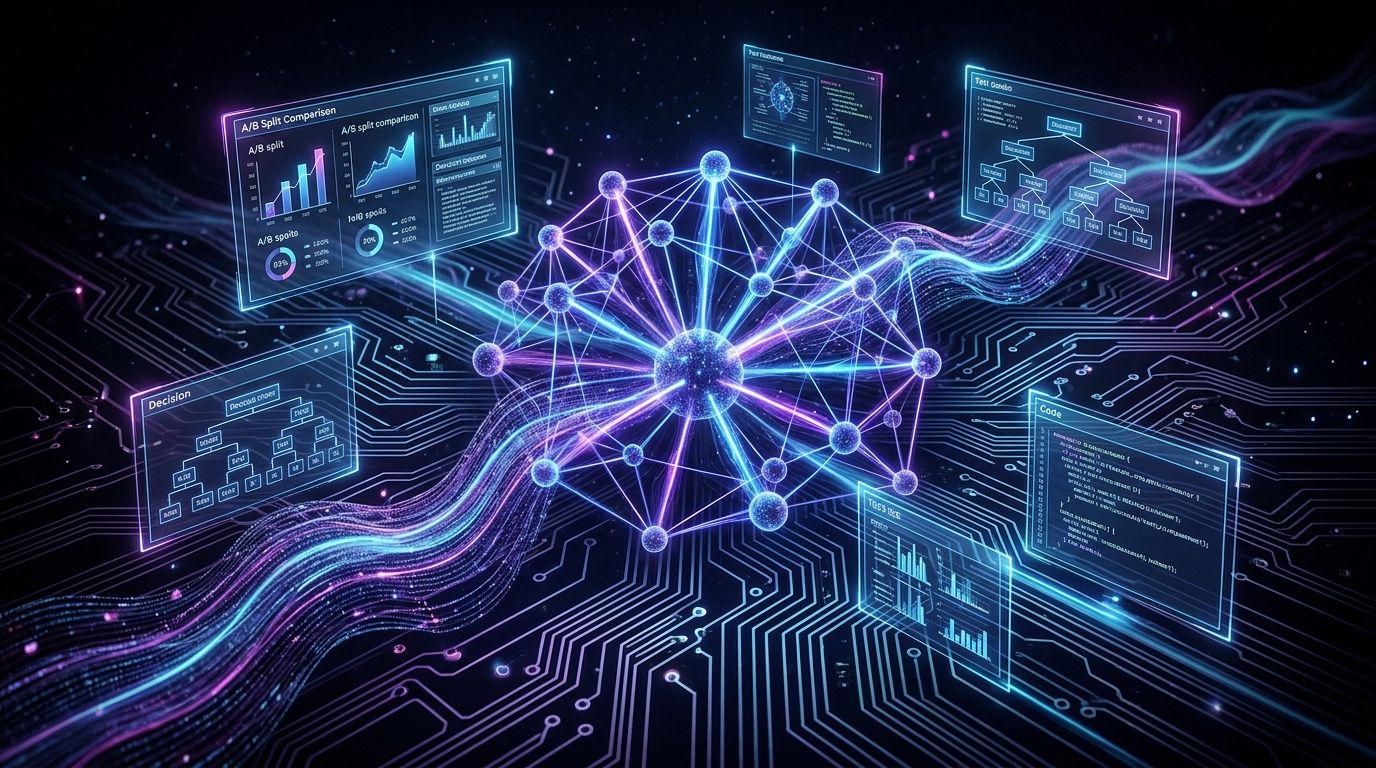
The Ultimate Feature Test: AI Systems, A/B Decisions & Dual-Model Synthesis
A comprehensive, kitchen-sink article testing every content feature: Mermaid diagrams, carousels, code blocks, multi-column tables, LaTeX math, GitHub alerts, A/B testing analysis, dual-solution comparison, and generated images — all woven into a real narrative about AI system design.
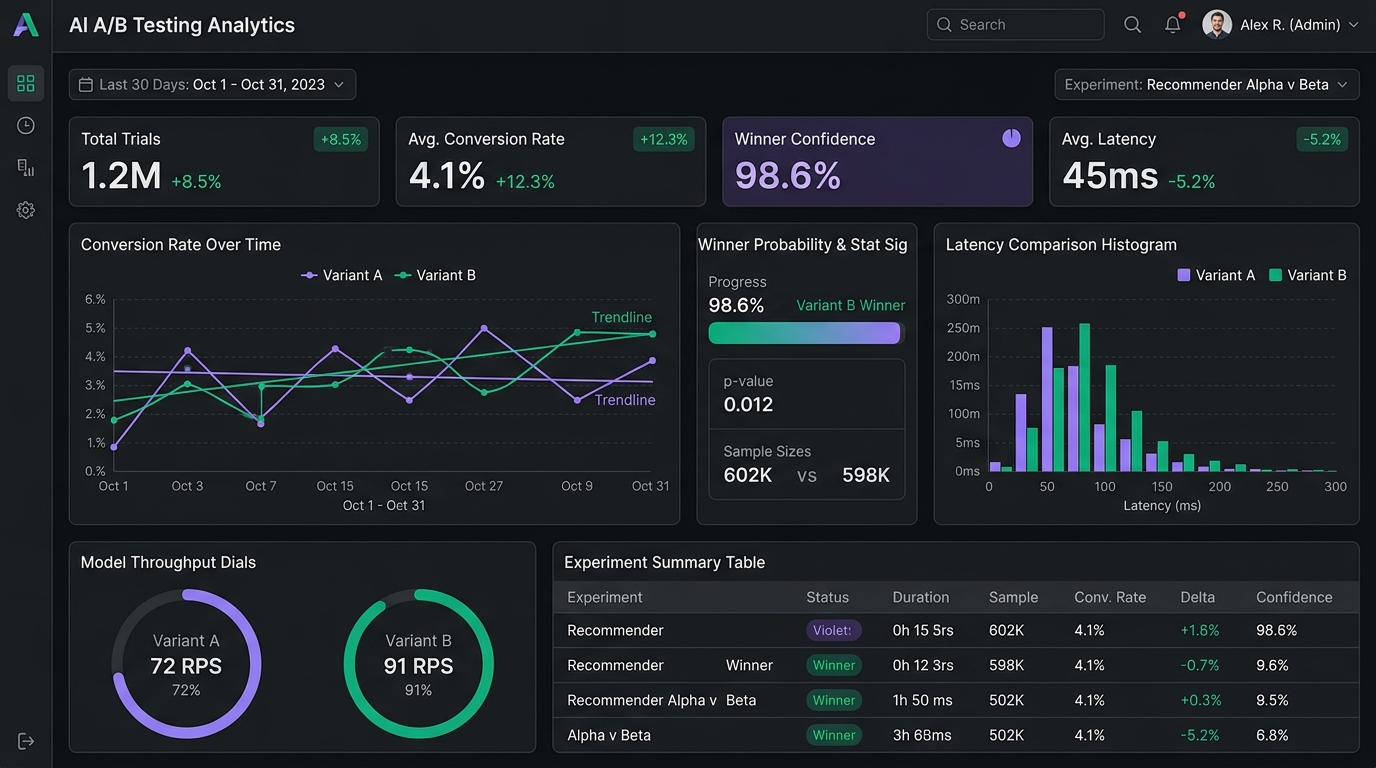
Autonomous Agent Orchestration & Comparative Model Synthesis: The Architecture of Adaptive Intelligence
A comprehensive deep dive into autonomous multi-agent systems, Bayesian A/B routing, dual-model speculative evaluation (ChatGPT/Gemini style), decision branching lineage, and production-scale telemetry.
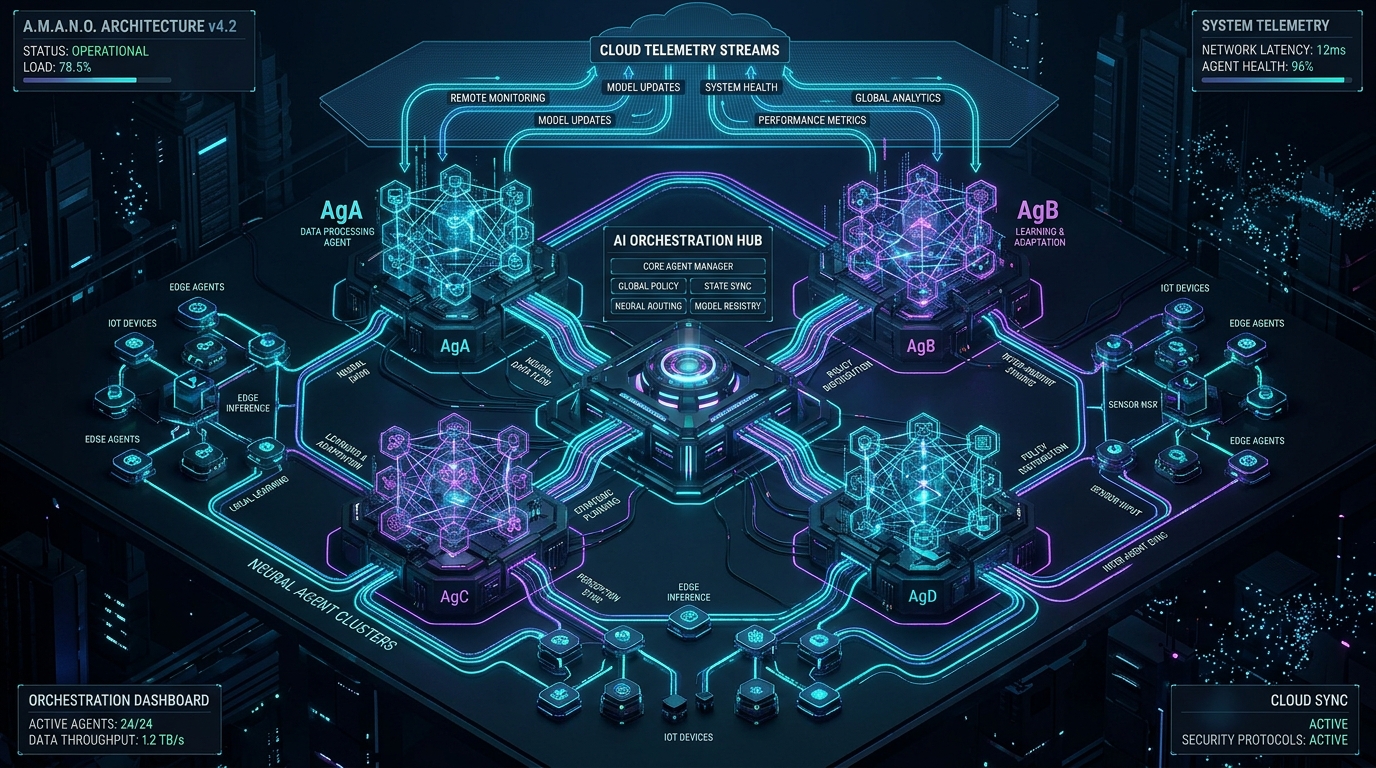
Autonomous Agent Orchestration & Comparative Model Synthesis
A comprehensive deep dive into autonomous multi-agent systems, Bayesian A/B routing, dual-model speculative evaluation (ChatGPT/Gemini style), decision branching lineage, and production-scale telemetry.
Deploying LLMs with vLLM and Ray
A comprehensive tutorial on setting up a high-throughput, low-latency LLM serving cluster using vLLM and Ray.