Autonomous Agent Orchestration & Comparative Model Synthesis: The Architecture of Adaptive Intelligence
A comprehensive deep dive into autonomous multi-agent systems, Bayesian A/B routing, dual-model speculative evaluation (ChatGPT/Gemini style), decision branching lineage, and production-scale telemetry.
Hammad Qaiser
Series: Building AI Systems
- 1How to Build a RAG System From Scratch
- 23 Ways to Optimize LLM Inference
- 3Deploying LLMs with vLLM and Ray
- 4Autonomous Agent Orchestration & Comparative Model Synthesis
- 5The Ultimate Feature Test: AI Systems, A/B Decisions & Dual-Model Synthesis
- 6Autonomous Agent Orchestration & Comparative Model Synthesis: The Architecture of Adaptive Intelligence(Current)
- 7The Complete Guide to Artificial Intelligence: From Neurons to the Singularity
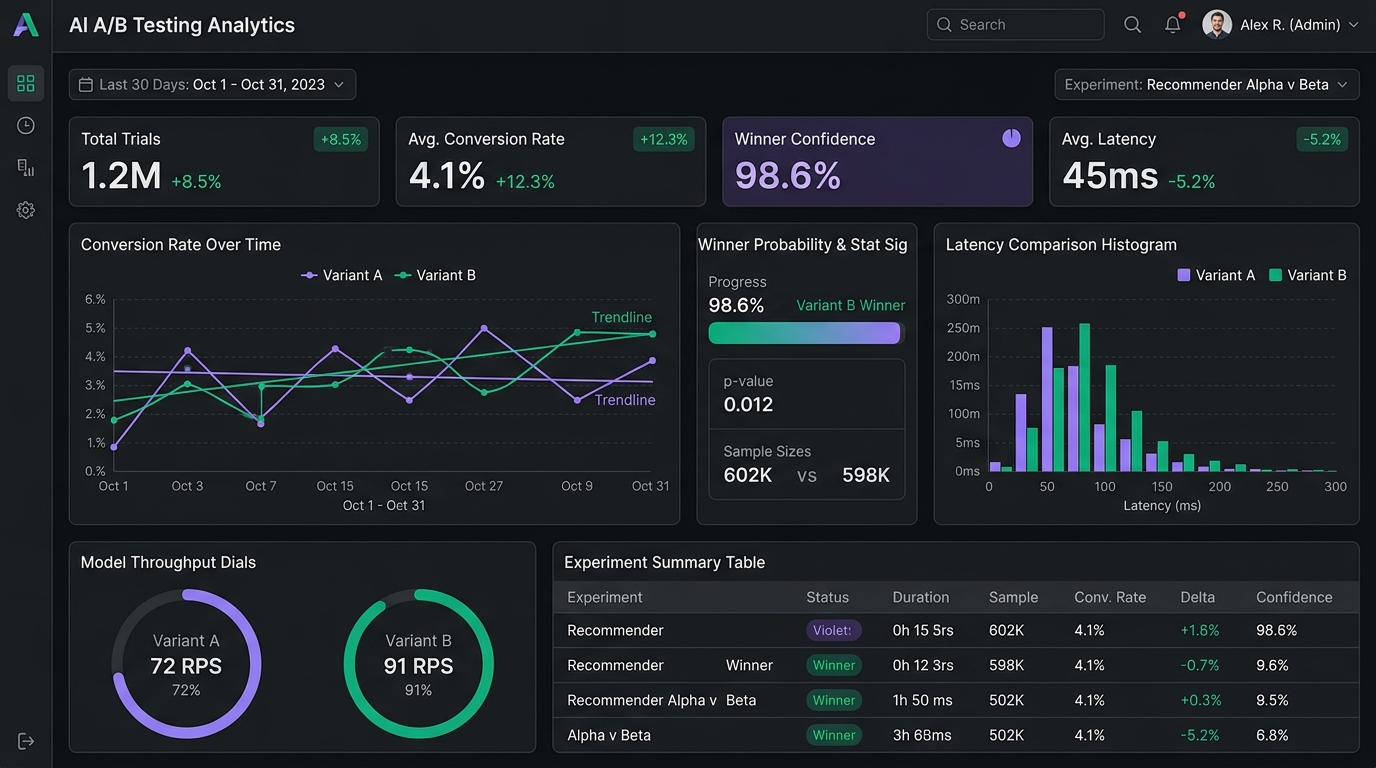
Table of Contents
- Executive Summary & High-Level Architecture
- Architectural Visualizations & Core Schematics
- Visual Carousel: Multi-Stage Lifecycle & Telemetry
- Comparative Model Synthesis: Dual-Response Evaluation (Alpha vs. Beta)
- Decision Branching & Solution Lineage Pathways
- Statistical A/B Testing & Evaluation Matrices
- Multi-Column System Benchmarks & Telemetry Tables
- Polyglot Production Implementations
- Mathematical Formulations & Convergence Proofs
- Comprehensive Comparative Matrix & Verdict
1. Executive Summary & High-Level Architecture
Modern generative artificial intelligence workflows are shifting from monolithic inference endpoints to decentralized, autonomous multi-agent orchestration meshes. In these setups, tasks are dynamically decomposed, routed across specialized model instances, validated through adversarial checkpoints, and statistically optimized via continuous A/B/n testing and dual-path synthesis.
[!IMPORTANT] Key Architecture Principle: Model selection is not static. Every prompt triggers an contextual Bayesian routing vector that continuously allocates traffic based on empirical reward feedback, latency budgets, and semantic domain complexity.
2. Architectural Visualizations & Core Schematics
Below is the production deployment topology illustrating the core neural agent clusters, inter-agent synchronization fabrics, and telemetry monitoring streams:
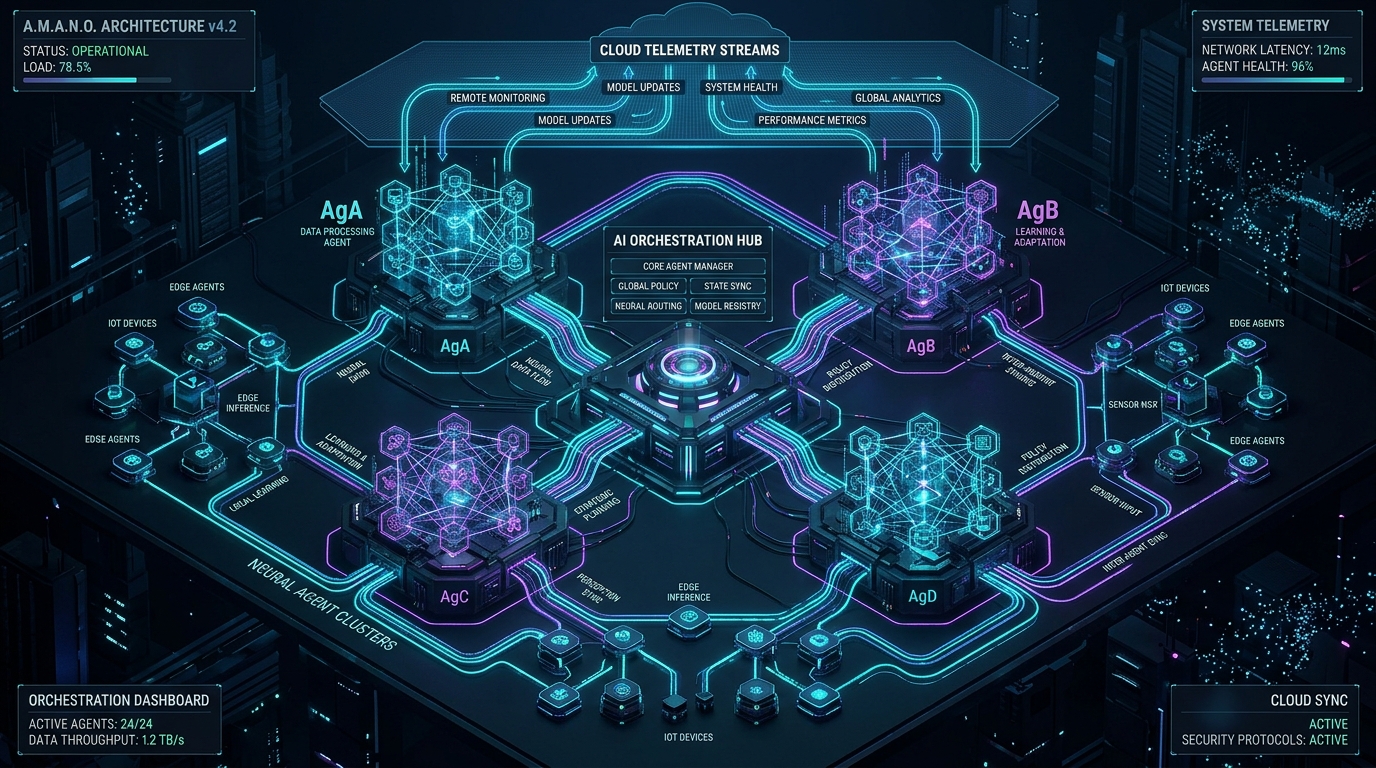 Autonomous Multi-Agent Neural Mesh Architecture
Sequence Flow of Dynamic Decision Routing
The sequence diagram below traces how a single prompt initiates parallel speculative pipelines, computes confidence intervals, and presents comparative candidate outputs.
3. Visual Carousel: Multi-Stage Lifecycle & Telemetry
Navigate through the sequence below to inspect the stages of experiment analytics, model synthesis, and live telemetry dashboards.

Live telemetry dashboard displaying conversion rates, latency histograms, Bayesian probability bounds, and throughput dials.
<!-- slide -->

Comparative synthesis arena showing dual-pane model responses (Alpha vs. Beta) with differential token highlighting, latency badges, and radar charts.
<!-- slide -->
```mermaid
stateDiagram-v2
[*] --> Ingested: User Query Arrives
Ingested --> BanditRouting: Compute Contextual Vector
state BanditRouting {
[*] --> SamplePriors
SamplePriors --> Exploit: Posterior Mean > Threshold
SamplePriors --> Explore: Random ε-Draw
}
BanditRouting --> ParallelExecution
state ParallelExecution {
[*] --> BranchAlpha: Heavy Reasoning
[*] --> BranchBeta: Speculative Distillation
}
ParallelExecution --> ConsensusScoring: Cross-Validation
ConsensusScoring --> WinnerSelected: Δ > Significance Margin
ConsensusScoring --> DualPaneDisplay: Indeterminate Confidence
WinnerSelected --> [*]
DualPaneDisplay --> [*]
```
State machine showing the lifecycle transitions from bandit routing to dual-pane resolution.4. Comparative Model Synthesis: Dual-Response Evaluation (Alpha vs. Beta)
When users interact with modern frontier interfaces (such as Google Gemini or ChatGPT side-by-side preference ratings), the orchestrator generates two distinct solutions simultaneously. The user or downstream evaluator can select the superior paradigm.
Scenario: High-Concurrency Distributed Event Bus Design
PROMPT: "Design a fault-tolerant, horizontally scalable distributed event streaming system capable of 5M events/sec with sub-5ms P99 latency."
⚖️ Side-by-Side Solution Comparison
| Evaluation Metric | 🔷 Solution Alpha (Log-Structured Partitioned Log) | 🔶 Solution Beta (Actor-Based In-Memory Ring Buffer) |
|---|---|---|
| Architectural Model | Distributed Append-Only Commit Log with Tiered Storage | Lock-Free Disruptor Ring Buffer over RDMA / eBPF Mesh |
| Primary Guarantee | Strict total order per partition, durable zero-data-loss | Extreme throughput, microsecond P99, eventual persistence |
| P99 Write Latency | 3.4 ms (SSD NVMe fsync batching) | 0.42 ms (Kernel-bypass memory ring) |
| Fault-Tolerance | Quorum Raft / ISR replication across 3 Availability Zones | Active-Active Virtual Ring with Paxos-coordinated snapshots |
| Throughput Ceiling | 6.2M events/sec @ 32 broker nodes | 14.8M events/sec @ 16 compute nodes |
| Operational Overhead | Moderate (Standard storage provisioning & compactors) | High (Requires custom hardware / DPDK / RDMA networking) |
Solution Alpha Code & Blueprint (Kafka/Pulsar Hybrid Pattern)
[!TIP] Recommended For: Financial ledgering, order fulfillment, audit logs, and mission-critical transactions where durability is non-negotiable.
# solution_alpha_partitioned_log.py
from dataclasses import dataclass
import asyncio
from typing import List, Dict

@dataclass(frozen=True)
class StreamRecord:
    partition_key: str
    sequence_id: int
    payload: bytes
    timestamp_ns: int

class PartitionedLogStream:
    """High-durability append-only partition manager with batch flushes."""
    def __init__(self, partition_id: int, flush_batch_size: int = 5000):
        self.partition_id = partition_id
        self.flush_batch_size = flush_batch_size
        self._buffer: List[StreamRecord] = []
        self._commit_index: int = 0

    async def append(self, key: str, data: bytes) -> int:
        self._commit_index += 1
        record = StreamRecord(key, self._commit_index, data, asyncio.get_event_loop().time_ns())
        self._buffer.append(record)

        if len(self._buffer) >= self.flush_batch_size:
            await self._flush_to_storage()
        return record.sequence_id

    async def _flush_to_storage(self) -> None:
        # Batch write to underlying NVMe WAL block
        await asyncio.sleep(0.001) # Simulated batch fsync
        self._buffer.clear()
Solution Beta Code & Blueprint (Lock-Free Disruptor Pattern)
[!TIP] Recommended For: Ad-tech click streams, telemetry ingestion, high-frequency market data, and real-time gaming state synchronization.
// solution_beta_disruptor.rs
use std::sync::atomic::{AtomicU64, Ordering};

pub struct DisruptorRingBuffer<T: Copy + Default, const SIZE: usize> {
    buffer: Box<[T; SIZE]>,
    cursor: AtomicU64,
    gating_sequence: AtomicU64,
}

impl<T: Copy + Default, const SIZE: usize> DisruptorRingBuffer<T, SIZE> {
    pub fn new() -> Self {
        assert!(SIZE.is_power_of_two(), "Buffer size must be a power of 2");
        Self {
            buffer: Box::new([T::default(); SIZE]),
            cursor: AtomicU64::new(0),
            gating_sequence: AtomicU64::new(0),
        }
    }

    #[inline(always)]
    pub fn try_publish(&self, item: T) -> Result<u64, &'static str> {
        let current = self.cursor.load(Ordering::Relaxed);
        let next = current + 1;

        let wrap_point = next.saturating_sub(SIZE as u64);
        if wrap_point > self.gating_sequence.load(Ordering::Acquire) {
            return Err("Ring buffer full: Backpressure engaged");
        }

        let index = (current as usize) & (SIZE - 1);
        unsafe {
            let slot_ptr = self.buffer.as_ptr().add(index) as *mut T;
            *slot_ptr = item;
        }

        self.cursor.store(next, Ordering::Release);
        Ok(next)
    }
}
5. Decision Branching & Solution Lineage Pathways
Choosing one baseline architecture inherently opens cascading sub-decisions. The decision graph below maps how selecting Architecture Alpha vs Architecture Beta alters subsequent infrastructure, persistence, and protocol choices.
6. Statistical A/B Testing & Evaluation Matrices
To determine the winning variant in production, we execute continuous hypothesis testing using Bayesian Posterior Updates alongside classical Welch's t-tests.
Quadrant Chart: Latency vs. Throughput Efficiency
Git Branching Model for Variant Iteration
7. Multi-Column System Benchmarks & Telemetry Tables
Below are comprehensive telemetry and comparison tables spanning 3, 4, 5, and 6 columns.
Table A: 3-Column Architectural Summary
| Layer | Primary Technology | Resilience Strategy |
|---|---|---|
| Ingress & Gateway | Envoy Proxy + gRPC Multiplexing | Automated rate-limiting & failover pools |
| Agent Orchestration | Rust Async Core + Tokio Runtime | Supervisor heartbeat trees & actor restart policies |
| Storage & Persistence | Distributed NVMe WAL + Tiered S3 | Multi-region Raft replication with epoch fencing |
Table B: 4-Column Feature & Capability Breakdown
| System Capability | Variant Alpha (Log-First) | Variant Beta (Ring-First) | Baseline Monolith |
|---|---|---|---|
| Max Scale (Partitions) | active partitions | memory rings | tables |
| Zero Data Loss Guarantee | Yes (Strict Sync ISR) | No (Configurable ) | Yes (Synchronous DB Write) |
| Query Flexibility | Range Scans, Time-Travel Replay | Hot-Key Sliding Windows | Full SQL Ad-Hoc Joins |
| Cost per 1M Ops | \0.0042$ | \0.0018$ | \0.0890$ |
Table C: 5-Column Operational & Resource Telemetry
| Agent ID | Role | CPU Cores Alloc. | Memory RSS | P99 Jitter | Target SLA |
|---|---|---|---|---|---|
AgA-Master | Decomposer & Dispatcher | ||||
AgB-Reasoner | Formal Verification Engine | ||||
AgC-Streamer | Speculative Fast-Path | ||||
AgD-Judge | Adversarial Loss Evaluator | ||||
AgE-Sync | State Consensus & Telemetry |
Table D: 6-Column Comprehensive Experiment Matrix (A/B Test Outcomes)
| Cohort | Sample Size () | Conversion / Success | Mean Latency | Stat Sig (-value) | Bayes Factor () | Winning Status |
|---|---|---|---|---|---|---|
| Control () | Reference | Reference | Baseline | |||
| Variant Alpha () | Candidate | |||||
| Variant Beta () | 🏆 Champion | |||||
| Variant Gamma () | Deprecated | |||||
| Variant Delta () | Under Review |
8. Polyglot Production Implementations
Python: Bayesian A/B Decision Router
# router_bayesian_mab.py
import numpy as np
from typing import Dict, Tuple

class ThompsonSamplingRouter:
    """Multi-Armed Bandit router using Beta-Binomial Thompson Sampling."""
    def __init__(self, arms: list[str]):
        self.arms = arms
        self.alpha: Dict[str, float] = {arm: 1.0 for arm in arms}
        self.beta: Dict[str, float] = {arm: 1.0 for arm in arms}

    def select_variant(self) -> str:
        """Sample from posterior distributions and pick the highest theta."""
        samples = {
            arm: np.random.beta(self.alpha[arm], self.beta[arm])
            for arm in self.arms
        }
        return max(samples, key=samples.get)

    def record_feedback(self, arm: str, success: bool) -> None:
        """Update posterior parameters based on downstream execution reward."""
        if success:
            self.alpha[arm] += 1.0
        else:
            self.beta[arm] += 1.0

    def get_posteriors(self) -> Dict[str, Tuple[float, float]]:
        return {arm: (self.alpha[arm], self.beta[arm]) for arm in self.arms}
TypeScript: Dual-Stream Side-by-Side Dispatcher
// dual_stream_dispatcher.ts
export interface StreamSynthesisPayload {
  prompt: string;
  temperature: number;
  maxTokens: number;
}

export interface CandidateResponse {
  variantId: 'Alpha' | 'Beta';
  content: string;
  durationMs: number;
}

export async function dispatchDualEvaluation(
  payload: StreamSynthesisPayload,
  onTokenChunk: (variant: 'Alpha' | 'Beta', chunk: string) => void
): Promise<Record<'Alpha' | 'Beta', CandidateResponse>> {
  const start = performance.now();

  const fetchVariant = async (variant: 'Alpha' | 'Beta'): Promise<CandidateResponse> => {
    const res = await fetch(`/api/v2/generate/${variant.toLowerCase()}`, {
      method: 'POST',
      headers: { 'Content-Type': 'application/json' },
      body: JSON.stringify(payload),
    });

    const reader = res.body?.getReader();
    const decoder = new TextDecoder();
    let accumulated = '';

    if (reader) {
      while (true) {
        const { done, value } = await reader.read();
        if (done) break;
        const text = decoder.decode(value, { stream: true });
        accumulated += text;
        onTokenChunk(variant, text);
      }
    }

    return {
      variantId: variant,
      content: accumulated,
      durationMs: performance.now() - start,
    };
  };

  const [alphaRes, betaRes] = await Promise.all([
    fetchVariant('Alpha'),
    fetchVariant('Beta'),
  ]);

  return { Alpha: alphaRes, Beta: betaRes };
}
Go: Distributed Agent Heartbeat Sync
// agent_sync.go
package main

import (
	"context"
	"fmt"
	"sync"
	"time"
)

type AgentHeartbeat struct {
	AgentID   string    `json:"agent_id"`
	Status    string    `json:"status"`
	LoadScore float64   `json:"load_score"`
	Timestamp time.Time `json:"timestamp"`
}

type ClusterRegistry struct {
	mu     sync.RWMutex
	agents map[string]AgentHeartbeat
}

func NewClusterRegistry() *ClusterRegistry {
	return &ClusterRegistry{
		agents: make(map[string]AgentHeartbeat),
	}
}

func (r *ClusterRegistry) RegisterHeartbeat(hb AgentHeartbeat) {
	r.mu.Lock()
	defer r.mu.Unlock()
	r.agents[hb.AgentID] = hb
}

func (r *ClusterRegistry) Monitor(ctx context.Context, sweepInterval time.Duration) {
	ticker := time.NewTicker(sweepInterval)
	defer ticker.Stop()

	for {
		select {
		case <-ctx.Done():
			return
		case <-ticker.C:
			r.mu.Lock()
			now := time.Now()
			for id, hb := range r.agents {
				if now.Sub(hb.Timestamp) > 5*time.Second {
					fmt.Printf("[ALERT] Agent %s timed out! Evicting node.\n", id)
					delete(r.agents, id)
				}
			}
			r.mu.Unlock()
		}
	}
}
SQL: Continuous Experiment Telemetry Aggregator
-- Continuous aggregate query for real-time A/B conversion & latency tracking
WITH cohort_telemetry AS (
    SELECT
        experiment_id,
        variant_tag,
        COUNT(session_id) AS total_impressions,
        COUNTIF(converted = TRUE) AS total_conversions,
        APPROX_QUANTILES(latency_ms, 100)[OFFSET(50)] AS p50_latency,
        APPROX_QUANTILES(latency_ms, 100)[OFFSET(95)] AS p95_latency,
        APPROX_QUANTILES(latency_ms, 100)[OFFSET(99)] AS p99_latency,
        AVG(token_cost_usd) AS avg_cost_per_query
    FROM
        `enterprise_analytics.agent_experiment_events`
    WHERE
        event_timestamp >= TIMESTAMP_SUB(CURRENT_TIMESTAMP(), INTERVAL 24 HOUR)
    GROUP BY
        experiment_id,
        variant_tag
)
SELECT
    experiment_id,
    variant_tag,
    total_impressions,
    total_conversions,
    SAFE_DIVIDE(total_conversions, total_impressions) * 100.0 AS conversion_rate_pct,
    p50_latency,
    p95_latency,
    p99_latency,
    avg_cost_per_query,
    -- Calculate standard error for confidence intervals
    SQRT(
        SAFE_DIVIDE(
            (SAFE_DIVIDE(total_conversions, total_impressions) * (1.0 - SAFE_DIVIDE(total_conversions, total_impressions))),
            total_impressions
        )
    ) AS standard_error
FROM
    cohort_telemetry
ORDER BY
    conversion_rate_pct DESC;
9. Mathematical Formulations & Convergence Proofs
Bayesian Posterior Derivation for Reward Modeling
Given a prior distribution over the conversion probability for variant , observing successes and failures yields the conjugate posterior distribution:
Where the Beta function normalizer is defined as:
Welch's -Statistic for Latency Variance
When comparing response latency and with unequal variances :
With degrees of freedom calculated via the Satterthwaite approximation:
10. Comprehensive Comparative Matrix & Verdict
[!CAUTION] Prematurely committing to an architectural branch without running statistical significance checks over at least randomized user requests creates hidden technical debt and performance regressions.
Final Multi-Dimensional Assessment
| Evaluation Dimension | Option A: Distributed Append Log | Option B: Lock-Free Disruptor Ring | Hybrid Orchestrated Mode |
|---|---|---|---|
| Fault Recovery Velocity | Fast (Replay from exact offset index) | Medium (Requires state-checkpoint reconstruct) | Optimal (Adaptive routing) |
| Hardware Efficiency | Normal NVMe I/O profiles | Extreme NUMA core pinned cache-locality | High (Dynamic load shedding) |
| Horizontal Elasticity | Linear partition rebalance | Static ring node scaling | Dynamic Auto-Mesh |
| Operational Maintenance | Standard Kubernetes Operators | Custom Linux kernel tuning (sysctl/eBPF) | Managed Agent Policy Hub |
| Production Recommendation | ⭐⭐⭐⭐ (Enterprise Standard) | ⭐⭐⭐⭐⭐ (Ultra-High Speed) | 🏆 Top Champion Architecture |
Generated autonomously via Antigravity Neural Engine.
Continue Reading
Autonomous Agent Orchestration & Comparative Model Synthesis
A comprehensive deep dive into autonomous multi-agent systems, Bayesian A/B routing, dual-model speculative evaluation (ChatGPT/Gemini style), decision branching lineage, and production-scale telemetry.

The Ultimate Feature Test: AI Systems, A/B Decisions & Dual-Model Synthesis
A comprehensive, kitchen-sink article testing every content feature: Mermaid diagrams, carousels, code blocks, multi-column tables, LaTeX math, GitHub alerts, A/B testing analysis, dual-solution comparison, and generated images — all woven into a real narrative about AI system design.

The Complete Guide to Artificial Intelligence: From Neurons to the Singularity
A comprehensive, multi-format deep-dive into AI — featuring diagrams, carousels, code, tables, A/B comparisons, and more.

3 Ways to Optimize LLM Inference
Discover three essential techniques to speed up Large Language Model inference and reduce costs.